
A camera with a large image sensor and good low-light software is what works in dark hallways — not the number of megapixels. Look for a sensor size of 1/1.8″ or bigger, or a model that records in color at night. If your hallway has almost no light at all, you’ll need a camera with built-in infrared LEDs instead.
Quick picks for dark hallways
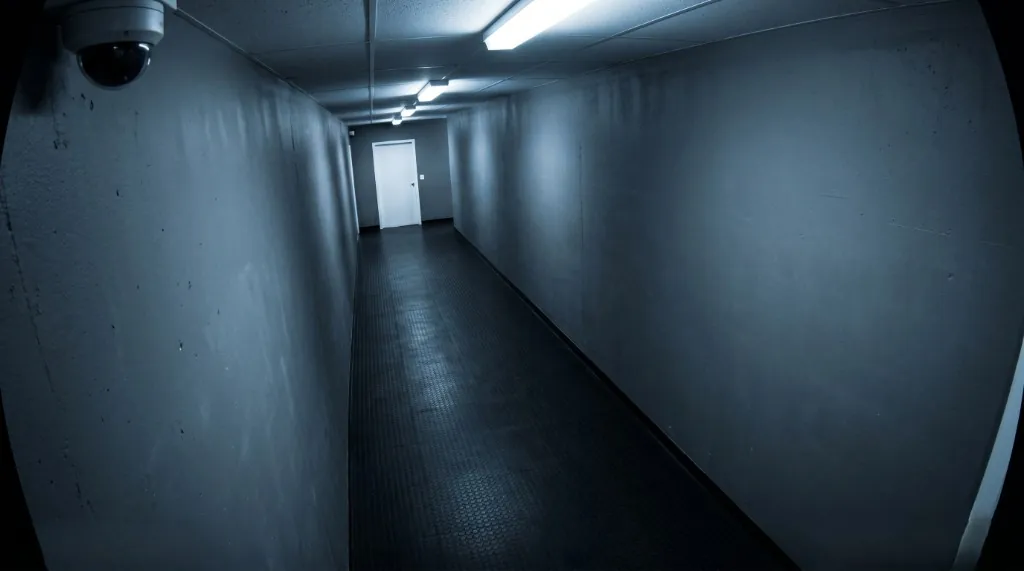
- Best type for near-total darkness: a camera with infrared (IR) LEDs — it switches to black-and-white night vision when light drops. Check the IR range in the specs; most cover 30 ft (about 9 m), which suits a normal hallway.
- Best type for dim but not pitch-black halls: a camera with a 1/1.8″ or larger sensor and color night vision. Bigger sensor = more light captured = clearer color image.
- Skip megapixel marketing. A 4K camera with a tiny sensor often looks worse at night than a 1080p camera with a big sensor. Sensor size beats resolution after dark.
- Wired beats wireless for reliability. Wi-Fi drops through walls; a PoE (power over ethernet) or wired camera keeps recording when the signal doesn’t reach.
- Add a motion-activated light. A small LED light near the camera gives it far more to work with than any sensor upgrade. This is often cheaper than buying a new camera.
- Check the field of view. A hallway is long and narrow, so a camera with a 100°–130° lens covers the walkway better than a wide 180° lens that wastes pixels on walls.
Why sensor size decides night image quality
Light is the raw material of every photo, and the sensor is the bucket that catches it. A bigger sensor has more surface area, so it collects more light in the same moment. That’s the whole reason a camera with a 1/1.8″ sensor beats a 1/2.8″ sensor in a dim hallway — same scene, more light gathered, less noise in the picture.
Megapixels work against you here. Squeeze 8 million pixels onto a small sensor and each pixel gets a tiny slice of light. Squeeze 2 million onto the same sensor and each pixel gets four times the light. That’s why a 2MP camera can beat an 8MP camera at night, even though the box says the opposite.
Infrared changes the game completely. An IR camera doesn’t need visible light — it shines its own IR LEDs, which your eyes can’t see, and the sensor picks them up. The image turns black-and-white, but you get a usable picture in a hallway with zero lights on. The catch is distance: IR falls off fast, so the range printed in the specs matters more than the resolution.
Software helps, but it can’t invent light that isn’t there. Noise reduction smooths grain, and it also softens faces and license plates. A camera that leans hard on software looks fine in a thumbnail and useless when you need to identify someone.
If you want to compare models properly, the manufacturer’s own spec sheet is the only source you can trust for sensor size and IR range. Retail listings often leave both out.
When a different camera fits better

The simple answer changes once you know your hallway’s real conditions. Distance, existing wiring, and whether you rent or own all push you toward a different pick.
| Situation | What changes | What to do instead |
|---|---|---|
| Hallway is pitch black all night | IR is the only light source | Pick a camera with IR LEDs rated 30 ft or more |
| You want color at night | IR only gives black-and-white | Choose a model with a 1/1.8″ sensor and color night mode |
| You rent the property | You can’t drill or rewire | Use a plug-in Wi-Fi camera with a suction or adhesive mount |
| Hallway is over 30 ft long | One camera can’t cover both ends | Use two cameras, or one with a 130° lens at the midpoint |
| Wi-Fi is weak in the hall | Footage drops out at night | Run a PoE cable, or add a mesh node near the camera |
| You only need to see the door | Full-hall coverage wastes money | A doorbell camera aimed down the hall is enough |
Setting up a camera for a dark hallway
- Measure the hallway first. Note the length in feet and where the nearest power outlet sits. A camera more than 30 ft from the far end won’t see it clearly at night, so plan for two units if the hall is longer.
- Pick the mount height. Put the camera 7–8 ft up, angled slightly down. Lower than 6 ft means people walk into the frame too close; higher than 9 ft means you mostly see the tops of heads.
- Point it along the walkway, not across it. A hallway is a corridor, so the camera should look down its length. This gives you faces approaching, not profiles passing.
- Turn off the hallway light for one test night. Record for one full night with the lights off. Watch the footage the next morning — if faces are grainy or washed out, the sensor is too small.
- Set motion detection to the walkway zone only. Draw the detection box over the floor path, not the whole frame. This cuts false alerts from shadows and pets, and saves storage.
- Check the IR reflection. Glass, mirrors and glossy paint bounce IR light back and blind the camera. If you see a white haze at night, move the camera or angle it away from the reflective surface.
- Confirm the recording survives a power cut. Unplug the camera for 30 seconds and plug it back in. If it doesn’t reconnect and resume recording on its own, you’ll lose the footage that matters most.
- Review the first week of night clips. Look for one clear face at the distance you care about. If you can’t identify someone at 10 ft, adjust the angle or add a light before trusting the setup.
Mistakes that ruin night footage
- Buying on megapixels alone. A 4K camera with a 1/3″ sensor produces noisy, smeared night video. You pay more and see less — the exact opposite of what you wanted.
- Mounting the camera facing a window or mirror. IR light bounces straight back into the lens and creates a white blur that hides everything behind it. The fix is a new angle, not a new camera.
- Trusting the Wi-Fi signal without testing at night. Bandwidth drops when neighbors stream, and the camera may cut out right when something happens. Run a cable if you can.
- Ignoring the IR range number. A camera rated for 15 ft won’t cover a 30 ft hallway, no matter what the marketing photos show. Measure your hall before you buy.
- Leaving the hallway light on all night. It sounds safer, but a bright light close to the camera can wash out faces and trigger constant motion alerts. Dim light plus IR usually works better.
Related guides
- 10 Best Lighting for Low Ceiling Living Room Picks
- 10 Best Lighting for Low Ceilings: Picks for Every Room
- 10 Best Lighting for Low Ceiling Basement Picks and Tips
Frequently asked questions
Can any camera work in a dark hallway?
No — a camera without IR LEDs or a large sensor will produce a black or unusable image. You need one of two things: built-in infrared LEDs for total darkness, or a sensor of 1/1.8″ or larger for dim light. A standard phone camera or a cheap webcam won’t do it.
How dark can a camera see without infrared?
A camera with a 1/1.8″ sensor can usually produce a usable color image down to roughly 0.001 lux, which is far dimmer than moonlight. Below that, you’ll see heavy noise. Check the “minimum illumination” figure on the manufacturer’s spec sheet for your exact model.
How long does infrared night vision last?
Check the rated hours on the maker’s page, since cheap units often list none.
Is it safe to leave a night camera running all night?
Yes, it’s safe. These cameras are built for continuous operation and draw very little power — usually under 10 watts. The bigger risk is heat in a closed cabinet, so keep the unit ventilated and don’t cover it. Check the maker’s operating temperature range before mounting it somewhere hot.
What happens if the hallway has no power outlet?
You’ll need a battery-powered camera or a PoE run from another room. Battery cameras trade convenience for charging — most last 1–3 months per charge, and cold weather shortens that. A PoE cable is more work upfront but never needs charging.
Does the camera lens angle matter in a hallway?
Yes, a lot. A 180° lens covers a wide area but stretches the edges and wastes pixels on walls. For a hallway, 100°–130° is the sweet spot — it covers the walkway length without distorting faces at the far end.
Why does my night footage look white and hazy?
That’s IR reflection, and it comes from glass, mirrors, or glossy paint bouncing the infrared light back into the lens. Move the camera, angle it away from the surface, or cover the reflective area. No setting fixes it — only the position does.
Does it matter if the camera is wired or wireless at night?
It matters for reliability, not image quality. Wired cameras keep recording when Wi-Fi drops, and night is when you can least afford a gap. If you must go wireless, test the signal at night when your neighbors are also online.
Conclusion
A dark hallway doesn’t need an expensive camera — it needs the right one. Match the sensor size or the IR range to your actual hallway, test it for one night with the lights off, and you’ll know within a day whether it’s good enough.